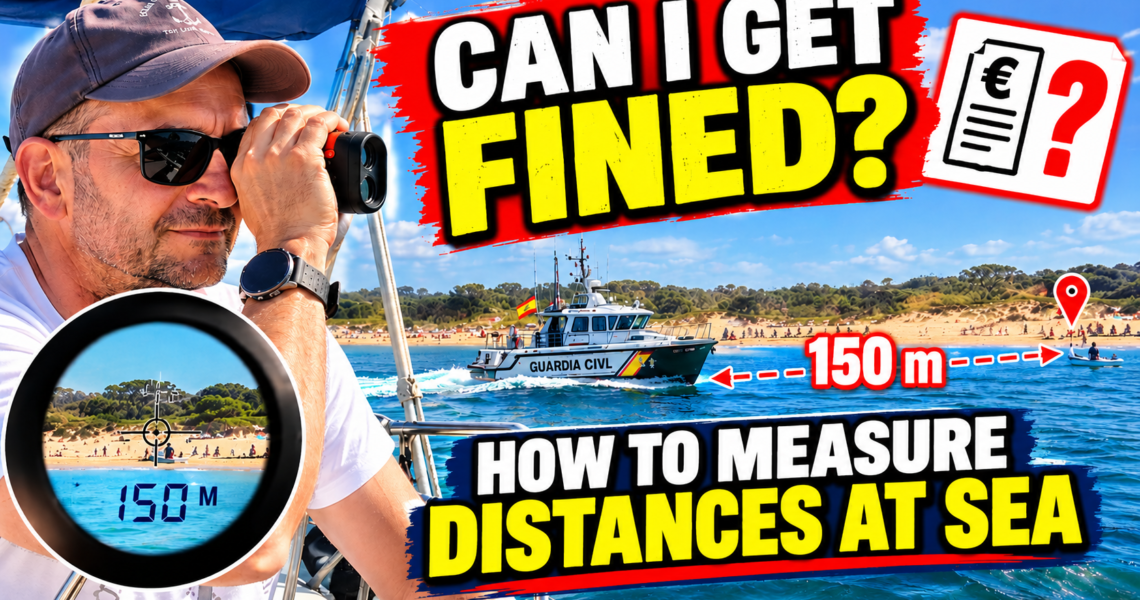
How to Measure Distances at Sea: A €40 Laser Rangefinder and Clever Sailing Tricks
What if you could measure distances of up to 1 kilometre (0.6 miles) from your boat with a gadget costing around €40? Well, you can! And the funny thing is, it wasn’t even designed for sailing. It’s a golf laser rangefinder! ⛳⛵
In this episode of The Low Cost Sailor, we’ll discover how to measure distances at sea using affordable tools, from calipers that measure fractions of a millimetre to a pocket-sized laser rangefinder with a claimed range of 1,000 metres. We’ll also explore anchoring distances, coastal regulations, why our eyes can deceive us and some surprisingly simple ways to estimate distances without expensive equipment.
Why Is Measuring Distances So Important on a Boat?
When we’re sailing, we’re constantly measuring things, often without even realising it. We need to know the diameter of a rope, the size of a bolt, the length of a stainless steel wire or the distance to a beach, some rocks or another boat.
And the longer the distance, the harder it usually becomes to judge. At sea, we have very few visual references, so our eyes can easily fool us. How many times have you dropped anchor thinking you were comfortably clear of another boat, only to look around a few minutes later and wonder whether you were actually far enough away?
Fortunately, there are plenty of affordable tools and clever tricks that can help us make much better estimates without spending a fortune.
Golf Laser Rangefinder: Measuring Up to 1,000 Metres from Your Boat
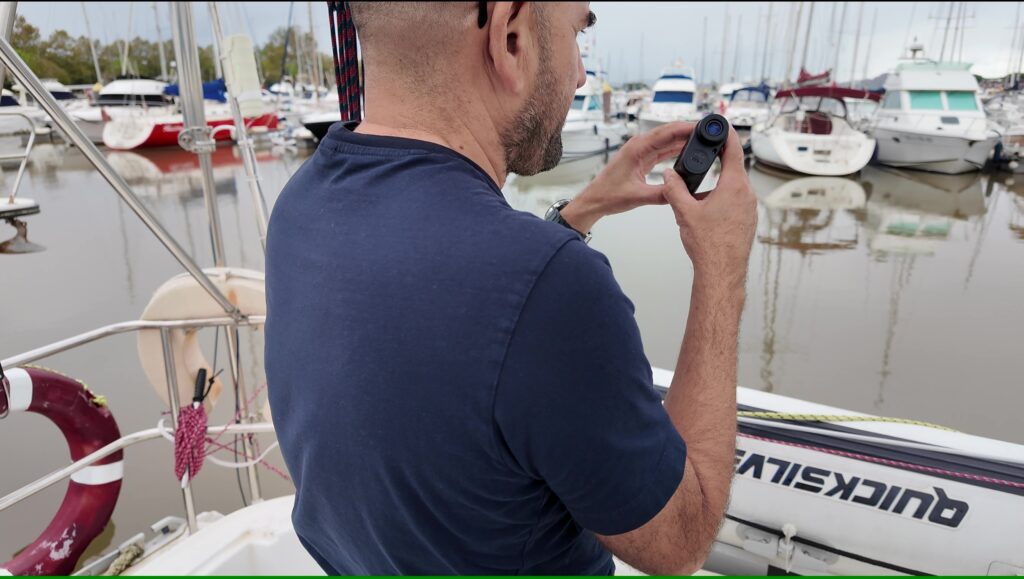
The star gadget in this episode is a golf laser rangefinder. Normally used by golfers to measure the distance to the flag, it turns out to have some very interesting applications for sailors too.
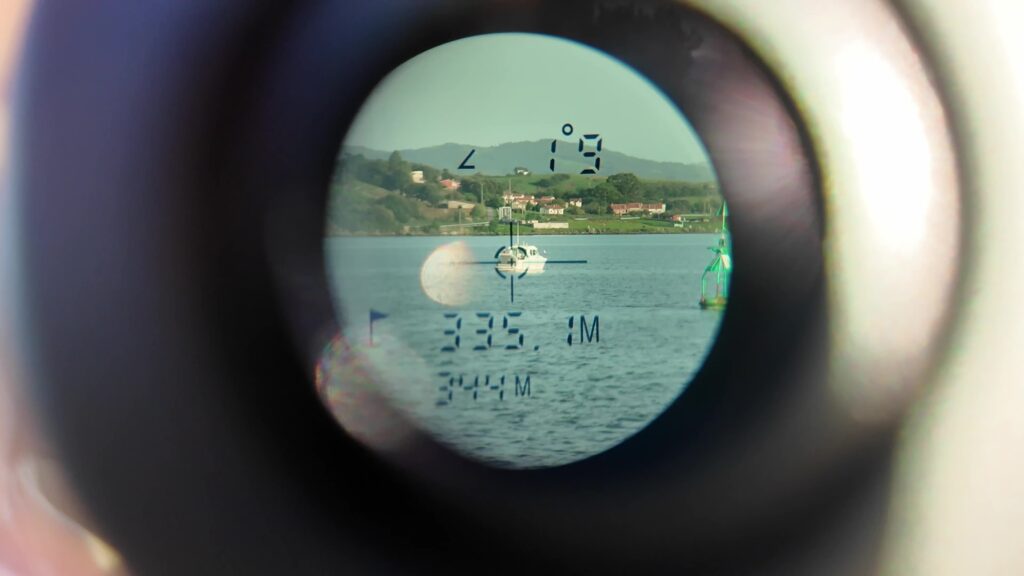
The model I tested has a claimed maximum range of 1,000 metres (about 0.62 miles) and cost me just €39.19. Simply point it towards an object and read the measured distance on its display. Of course, real-world range and accuracy depend on the target, lighting, weather and other measuring conditions.
What Can You Use a Laser Rangefinder for on a Sailboat?
- Measuring the distance to neighbouring boats while anchored.
- Checking how far you are from a beach, rocks or a breakwater.
- Comparing repeated measurements to see whether the distance to another object is changing.
- Estimating clearances during manoeuvres and other sailing situations.
- Measuring distances to visible landmarks that may not be accurately represented on your electronic charts.
A rangefinder is a useful additional tool, but it doesn’t replace proper navigation equipment, a safe lookout or good seamanship. You also need a target that reflects the laser well enough to produce a reliable reading.
Where to Buy an Affordable Laser Rangefinder
⛳ Golf laser rangefinder (up to 1,000 m):
👉 Buy on AliExpress
👉 Buy on Amazon
⛳ Multifunction hunting laser rangefinder (with height measurement functions):
👉 Buy on AliExpress
👉 Buy on Amazon
Some multifunction rangefinders include additional modes for estimating heights or elevation differences using angular measurements. These features can be useful for experimenting with other applications on board, although you should always check the specifications of the particular model.
Can You Anchor Within 200 Metres of a Beach in Spain?
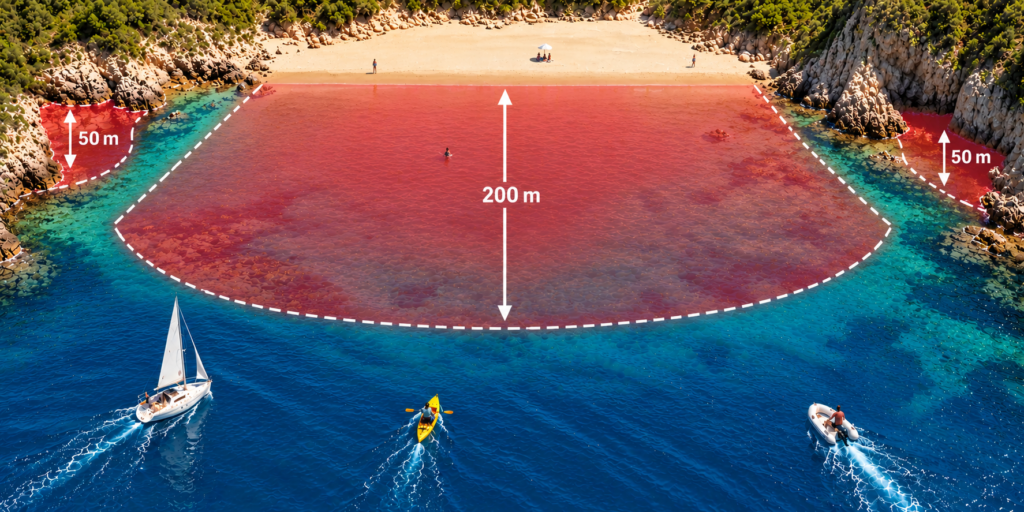
One of the most common misconceptions among boaters in Spain is that anchoring within 200 metres of a beach, or 50 metres of any other coastline, is always prohibited. But what do the regulations actually say?
Article 73 of Spain’s General Coastal Regulations (Royal Decree 876/2014) distinguishes between designated swimming areas marked by buoys and swimming areas without such markings.
- Marked swimming areas: recreational boating, including motorboats and sailing vessels, is prohibited within these areas. Boats must use properly designated channels for launching and beaching.
- Unmarked swimming areas: for the purposes of these regulations, the swimming area extends 200 metres (656 ft) from beaches and 50 metres (164 ft) from other parts of the coastline. Navigation within these areas is limited to a maximum of 3 knots, with appropriate precautions to protect swimmers.
These distances therefore do not, by themselves, create a blanket ban on anchoring. However, that doesn’t mean you can anchor anywhere. Additional restrictions may apply under local maritime regulations, port rules, protected-area regulations or other applicable laws. Swimmer safety must always come first.
Important: this section explains Spanish coastal regulations. Rules on anchoring, swimming areas and minimum distances vary between countries and sometimes between individual coastal areas.
You can consult the official Spanish legislation here:
- General Coastal Regulations, Article 73 (Spanish Official State Gazette).
- Spanish Coastal Law, Article 31 (Official State Gazette).
How to Use Vernier and Digital Calipers on a Boat
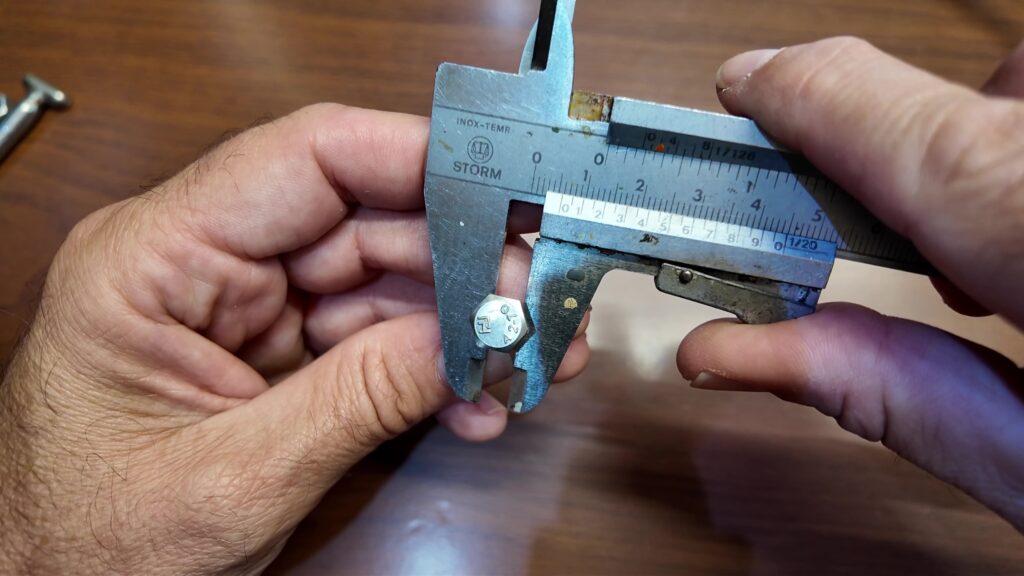
For smaller measurements, one of the most useful tools you can keep on board is a caliper, also known as a vernier caliper, sliding caliper or digital caliper.
Calipers are ideal for measuring rope and wire diameters, material thickness, bolt diameters and small fittings. Traditional vernier calipers use a secondary scale to read fractions of a millimetre, while digital versions display the measurement directly.
Metric Bolt Size Chart: Diameter, Spanner Size and Thread Pitch
One particularly useful application of calipers is identifying metric bolts and nuts. For example, an M6 bolt has a nominal thread diameter of 6 mm. That doesn’t mean its nut measures 6 mm across the flats: the nut is considerably wider.
The following chart shows common ISO metric coarse-thread sizes. Spanner sizes refer to typical hexagonal nuts, but may vary depending on the applicable standard and nut design.
| Thread | Nominal diameter | Typical spanner size (AF) | Coarse thread pitch |
|---|---|---|---|
| M3 | 3 mm | 5.5 mm | 0.50 mm |
| M4 | 4 mm | 7 mm | 0.70 mm |
| M5 | 5 mm | 8 mm | 0.80 mm |
| M6 | 6 mm | 10 mm | 1.00 mm |
| M8 | 8 mm | 13 mm | 1.25 mm |
| M10 | 10 mm | 16 or 17 mm | 1.50 mm |
| M12 | 12 mm | 18 or 19 mm | 1.75 mm |
| M14 | 14 mm | 21 or 22 mm | 2.00 mm |
| M16 | 16 mm | 24 mm | 2.00 mm |
To identify a bolt correctly, check its nominal diameter, thread pitch and length. For an external thread, measure across the thread crests. When measuring the inside of a nut with calipers, remember that the measured opening is smaller than the nominal thread diameter.
And a useful reminder for sailors: metric and imperial threads are not interchangeable. If you’re working on older equipment, imported fittings or hardware of uncertain origin, don’t assume every bolt uses a metric thread.
Where to Buy Calipers
📏 Traditional vernier caliper:
👉 AliExpress
📏 Stainless steel digital caliper:
👉 AliExpress
📏 Plastic digital caliper (the one I use):
👉 AliExpress
👉 Amazon: caliper option
Measuring Tapes and Laser Distance Meters for Boat DIY
When measuring the inside of a boat, checking rope lengths or working on the rigging, more conventional measuring tools can be extremely useful.
An indoor laser distance meter makes measuring several metres quick and easy, especially when you’re working alone. Outdoors, however, bright sunlight, reflective surfaces and poorly defined targets can make readings difficult or even impossible.
For longer measurements, a 30-metre fibreglass measuring tape is an inexpensive and practical solution. And a cross-line laser level can help establish straight reference lines and check alignment during boat maintenance and DIY projects.
📐 Indoor laser distance meter:
👉 AliExpress
👉 Amazon
📏 30 m fibreglass measuring tape:
👉 Obramat (Spain)
👉 Amazon
📐 Cross-line laser level:
👉 AliExpress
👉 Amazon
Measuring Distances with GPS, AIS and Nautical Charts
Our navigation electronics can also help us measure distances. With GPS and electronic nautical charts, we can calculate the distance to a known position. And with AIS, we can see the reported position and distance of vessels transmitting valid AIS information.
But what about a small anchored boat without AIS? Or when we want to know the distance to the actual waterline of a beach, which changes with the tide? That’s where a laser rangefinder or some simple estimation techniques can complement our navigation electronics.
Distance to the Horizon: A Simple Trick for Estimating Nautical Miles
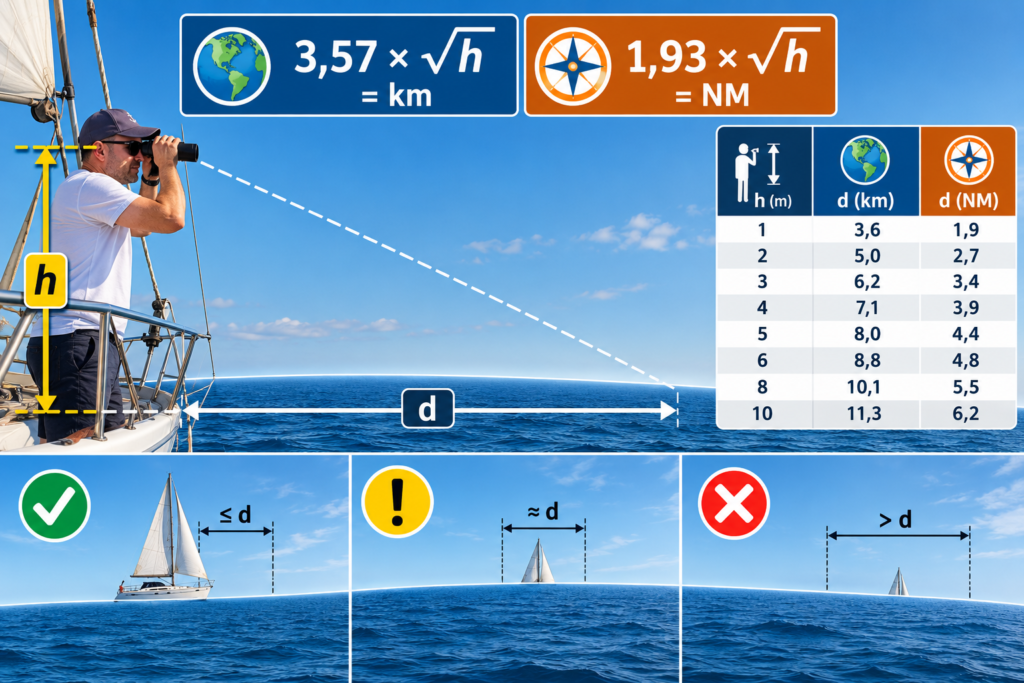
One of the most useful natural references at sea is the horizon itself. The distance to the horizon depends on the height of your eyes above the water.
Ignoring atmospheric refraction, we can use these approximate formulas:
Distance to horizon (km) ≈ 3.57 × √(eye height in metres)
Distance to horizon (nautical miles) ≈ 1.93 × √(eye height in metres)
For example, if your eyes are approximately 2.4 metres above the water, your geometric horizon is about 3 nautical miles away.
Horizon Distance Chart by Eye Height
| Eye height above sea | Horizon distance (km) | Horizon distance (NM) |
|---|---|---|
| 1 m | 3.57 km | 1.93 NM |
| 1.5 m | 4.37 km | 2.36 NM |
| 2 m | 5.05 km | 2.73 NM |
| 2.4 m | 5.53 km | 2.99 NM |
| 2.5 m | 5.64 km | 3.05 NM |
| 3 m | 6.18 km | 3.34 NM |
| 4 m | 7.14 km | 3.86 NM |
| 9 m | 10.71 km | 5.79 NM |
Of course, this doesn’t mean you can’t see objects beyond your own horizon. If another sailboat is farther away, its mast may still be visible even after its hull has disappeared below the horizon. The object’s height, atmospheric refraction and visibility conditions all affect what you can see.
How to Measure the Distance to Another Boat with Calipers and Trigonometry
And now for one of my favourite tricks: using the same calipers we use to measure bolts to estimate the distance to another boat hundreds of metres away.
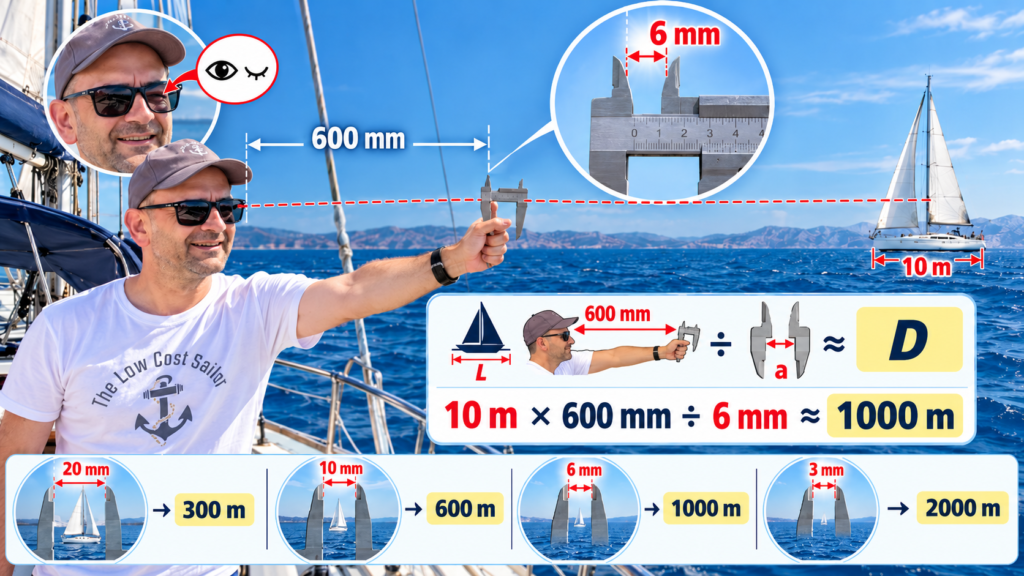
The idea is surprisingly simple. Close one eye, extend your arm and hold the calipers at a consistent distance from your eye. Adjust the jaws until their opening appears to match the visible length of the boat you’re looking at.
If you know the approximate length of that boat, you can estimate its distance using a small-angle relationship:
Distance ≈ actual object size × eye-to-caliper distance ÷ caliper opening
Imagine a boat 10 metres long, calipers held 600 mm from your eye and an apparent opening of just 6 mm:
10 m × 600 mm ÷ 6 mm = 1,000 m
That’s one kilometre! Naturally, this is only an estimate. You need to know the object’s actual size, keep the eye-to-caliper distance consistent and preferably observe the other boat broadside. Movement of both boats introduces additional errors.
Caliper Distance Estimation Chart
Assuming a 10-metre boat viewed broadside and a fixed distance of 600 mm between your eye and the calipers:
| Apparent caliper opening | Estimated distance |
|---|---|
| 30 mm | 200 m |
| 20 mm | 300 m |
| 15 mm | 400 m |
| 10 mm | 600 m |
| 6 mm | 1,000 m |
| 4 mm | 1,500 m |
| 3 mm | 2,000 m |
| 2 mm | 3,000 m |
It’s a fascinating demonstration of how a little geometry and a known reference can help us estimate distances far greater than the physical size of the measuring tool would suggest.
Which Measuring Tools Are Worth Keeping on a Sailboat?
It all depends on what you need to measure. Calipers are ideal for bolts, fittings and wire diameters; a measuring tape is useful for boat dimensions and rigging; an indoor laser meter is handy for DIY projects; and a golf rangefinder can help measure much longer distances to visible targets.
But the most valuable skill is learning to use references. Your own boat’s length, the horizon, a nautical chart or an object of known size can all help you estimate distances when you don’t have the perfect instrument available.
After all, good seamanship is partly about knowing where you are, how far away things are and how much safety margin you have.
And if we can do it with inexpensive gadgets and a little ingenuity, even better! 😁⛵
How Do You Measure Distances at Sea?
Had you heard of using a golf laser rangefinder on a boat? Have you ever tried anything similar with calipers? What other clever, low-cost measuring tools do you keep on board?
Tell us in the comments! And don’t forget to visit The Low Cost Sailor on YouTube, where we share sailing adventures, practical experiments, DIY projects and affordable ways to make life on board easier.
Affiliate disclosure: some shopping links in this article are affiliate links. We may earn a small commission if you purchase through them, at no additional cost to you. Prices, availability and product specifications may change.