Boat Solar Made Easy: Complete DIY 12V Solar System Guide
Want to install solar panels on your boat and keep your batteries charged without constantly running the engine or plugging into shore power? A simple 12V solar system can give your sailboat a surprising amount of energy independence — and building one is easier and more affordable than you might think.
In this guide, we’ll explain how to build a DIY boat solar system from the ground up: how to choose solar panels, the difference between PWM and MPPT solar charge controllers, flexible vs rigid panels, wiring, cable sizing, batteries and how everything connects together.
Although we’re doing this installation on a sailboat, the same principles apply to many 12V off-grid solar systems, including campervans, RVs, motorhomes, cabins and other vehicles or installations where you want to generate and store your own electricity.
Why install solar panels on a boat?
One of the biggest advantages of having solar power aboard a sailboat is energy independence. When we’re away from the marina, our batteries still need to power navigation electronics, lights, instruments, phones, tablets, refrigeration, autopilots and many other devices.
Without renewable energy, that electricity normally has to come from the engine alternator, a generator or shore power. Solar panels can quietly produce electricity whenever there is enough sunlight, helping to keep the batteries charged while we’re sailing or sitting at anchor.
And unlike fuel, sunlight doesn’t send us a bill. ☀️
How does a basic 12V boat solar system work?
At its simplest, a 12V solar installation requires surprisingly few components. The basic system consists of a solar panel, a solar charge controller, a battery and the appropriate cables and protection devices.
The basic energy path is:
Solar panel → Solar charge controller → 12V battery → Boat electrical system
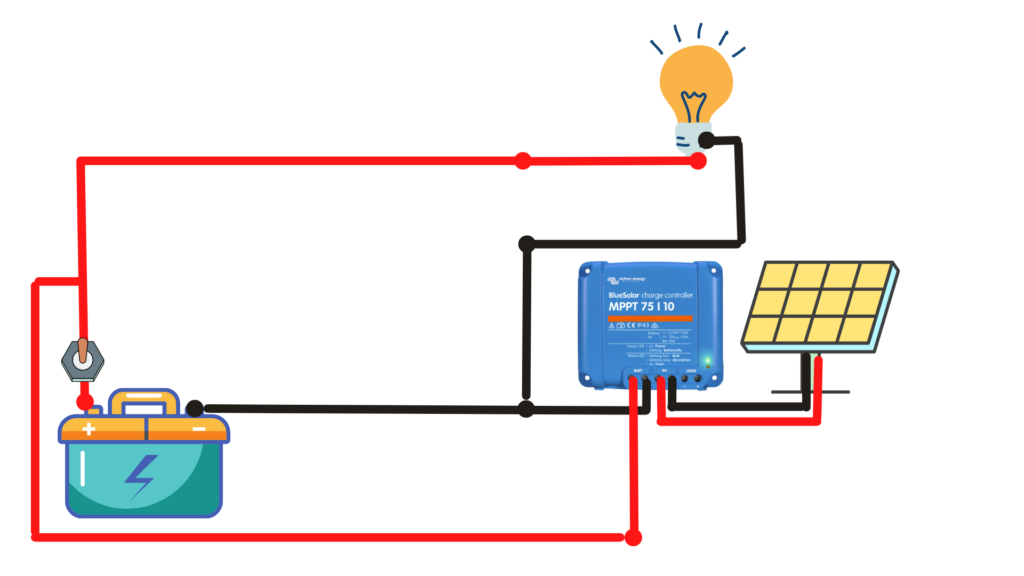
The solar panel produces electricity, but we should not normally connect it directly to the battery. A solar charge controller sits between the panel and battery and manages the charging process.
Portable solar kits: the easiest option
If you don’t want to make a permanent installation, a portable solar panel kit can be one of the easiest ways to start generating your own electricity.
Portable and folding solar kits can be particularly useful on smaller boats where there isn’t enough permanent space for solar panels. They can be stored when you’re sailing and deployed when you’re at anchor. The same idea works extremely well for RVs, campervans and emergency power systems.
Flexible vs rigid solar panels for boats
Choosing the right solar panel for a boat is not simply a matter of buying the panel with the highest wattage. Available space, weight, installation location, ventilation and shading all matter.
Flexible solar panels
Flexible solar panels are especially attractive on sailboats because they are thin and lightweight and can be installed on surfaces where a conventional rigid panel would be difficult to mount. Depending on the installation, they can be fitted to the coachroof, deck or even suitable canvas structures.
For marine installations, we generally prefer good-quality ETFE flexible solar panels. However, flexible panels need to be installed carefully. Excessive heat, poor-quality construction, repeated flexing and partial shading can significantly reduce their performance and lifespan.
Rigid solar panels
If you have enough space for a proper mounting structure, rigid solar panels can be an excellent alternative. They are normally easier to ventilate and can offer very good durability and value per watt.
On a boat, the biggest challenge is usually finding somewhere to put them without interfering with sails, lines, access to the deck or normal operation of the boat.
PWM vs MPPT solar charge controllers
The solar charge controller is one of the most important components in the system. Its job is to take the energy produced by the solar panels and use it to charge the batteries correctly.
Two technologies are commonly found in small solar installations: PWM (Pulse Width Modulation) and MPPT (Maximum Power Point Tracking).
PWM solar controllers
PWM controllers are simple and inexpensive, which makes them attractive for very basic or low-cost solar installations. You will find them included in many inexpensive solar kits.
MPPT solar controllers
An MPPT solar charge controller is more sophisticated. It continuously searches for the operating point at which the solar panel can deliver its maximum available power and converts that power efficiently to the voltage required to charge the battery.
This is why an MPPT controller is generally our preferred solution for a more capable permanent boat solar installation. It also gives us greater flexibility when choosing the voltage and configuration of our solar panels.
Solar panels in series or parallel?
If you’re installing more than one solar panel, another important decision is whether to connect the panels in series or in parallel.
A series connection increases voltage while the current remains essentially that of one panel. A parallel connection keeps the voltage similar while increasing the available current.
There isn’t one configuration that is automatically best for every boat. The correct solution depends on the panels, the charge controller, cable runs, system voltage and — particularly on a sailboat — the effect of partial shading.
Shading: one of the biggest enemies of boat solar
A solar panel needs sunlight, which sounds obvious until you install one on a sailboat. Our boats are full of things that create shadows: the mast, boom, standing rigging, running rigging, sails, antennas and other equipment.
Even a relatively small shadow can have a surprisingly large effect on solar output. That’s why panel location and the electrical configuration of multiple panels deserve careful consideration before making the installation permanent.
Solar equipment and components
Here are some examples of the equipment and components discussed in the video. Product availability and prices change over time, so always check the current specifications and make sure each component is suitable for your particular electrical system before buying.
☀️ Portable solar kits
- AliExpress – portable solar kits: View on AliExpress
- Amazon – 150W portable solar kit: View on Amazon
☀️ Simple solar kits with PWM controllers
- AliExpress: View solar kits
- Amazon: View solar kits
☀️ Flexible solar panels – ETFE recommended
- AliExpress: View flexible solar panels
- Amazon: View flexible solar panels
☀️ Rigid solar panels
- Amazon: View rigid solar panels
⚡ MPPT solar charge controllers
- Victron 15A MPPT – our recommendation: View on Amazon
- Victron 30A MPPT: View on Amazon
- EPEVER MPPT – AliExpress: View on AliExpress
🔌 Ready-made solar cables
- AliExpress: View solar cables
- Amazon: View solar cables
🔌 Solar connectors
- AliExpress: View solar connectors
- Amazon: View solar connectors
🔌 Parallel solar panel connectors
- AliExpress: View parallel connectors
- Amazon: View parallel connectors
Some of the links above are affiliate links. If you purchase something through them, we may receive a small commission at no additional cost to you. This helps us continue producing projects and videos for The Low Cost Sailor.
Choosing the right cable size for a 12V solar installation
Do not underestimate the importance of the wiring. Cable size is particularly important in a 12V electrical system, where relatively high currents and voltage drop can quickly become a problem.
Keep cable runs as short as reasonably possible and use an appropriate conductor size for the maximum current and length of the circuit. In a marine environment, good-quality tinned copper marine cable is preferable because it offers better resistance to corrosion.
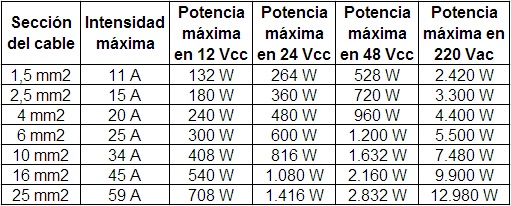
Remember that conductor sizing is not determined by power alone. Cable length, current, acceptable voltage drop, insulation, installation conditions and circuit protection also need to be considered.
Combining solar with the engine alternator and shore power
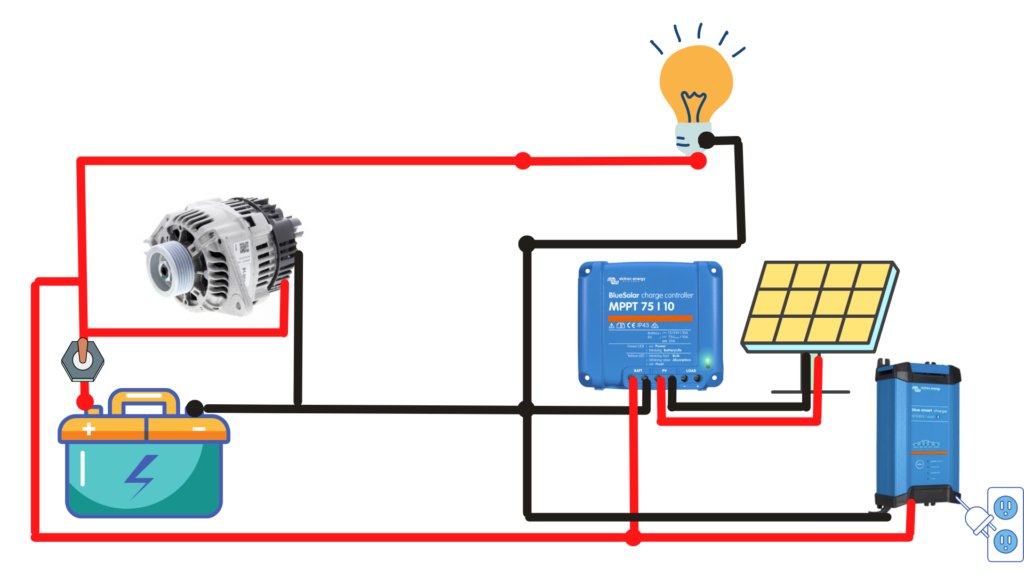
A boat electrical system will normally have more than one way of charging its batteries. Solar power can coexist with an engine alternator, shore-power battery charger and other charging sources.
A more complete boat charging system might therefore look like this:
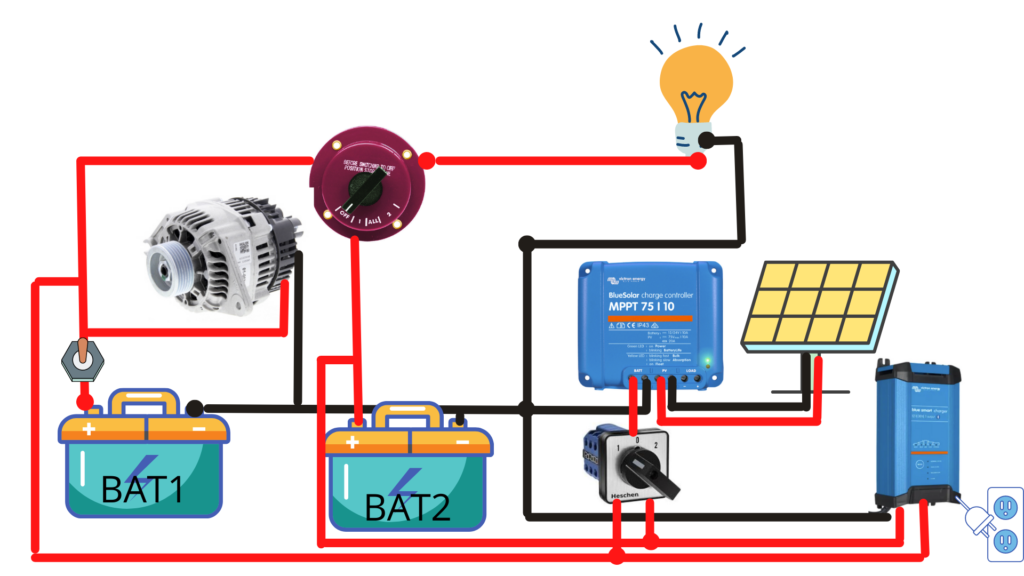
What if your boat has more than one battery?
Many sailboats have multiple batteries or battery banks — typically separating the engine starting battery from the domestic or house bank.
In our installation, battery selectors allow us to control which battery is being charged and which battery supplies the onboard services. The complete system therefore looks more like this:
From 12V battery power to 120V or 230V AC
Once you’ve generated solar energy and stored it in your batteries, you can use that electricity directly for your 12V equipment or, when appropriate, use an inverter to power AC equipment.
We’ve covered inverters, AC power and even running appliances such as a microwave from a boat electrical system in another guide:
👉 Inverters, microwaves and AC power on a boat
Is boat solar really worth it?
For us, absolutely. A well-designed boat solar system doesn’t just reduce the amount of fuel or shore power we use. It changes how we can use the boat.
Being able to arrive at an anchorage, switch off the engine and continue producing electricity silently gives us considerably more freedom. Our navigation equipment, lights, phones and other onboard systems can keep running while the sun helps replenish the energy we’ve consumed.
And you don’t need an enormous or expensive installation to get started. Even a relatively small solar system can make a noticeable difference to the energy balance aboard a sailboat.
Watch the complete boat solar installation
In the complete video we explain the process in much more detail, including portable solar kits, flexible and rigid panels, PWM vs MPPT controllers, installation, shading and the practical advantages of producing your own electricity aboard.
If the video or this guide helped you, please subscribe to The Low Cost Sailor on YouTube, share it with another sailor and leave us a comment. Every view, subscription and purchase through our affiliate links helps us keep experimenting, building and sharing affordable sailing projects.
Fair winds! ⛵☀️